Jakarta, September 2026 — The Faculty of Social Sciences and Law, Universitas Negeri Jakarta (FISH UNJ), continues to strengthen the internationalization of learning through cross-border academic collaboration. As part of this commitment, the Communication Science Study Program organized an international guest lecture entitled “Globalization and Southeast Asian Regionalism: Dynamics and Dilemmas.” The event was held online via Zoom and attended by Communication Science students from the 2024 cohort.
The guest lecture featured Mohd. Nur Najmi Nuji, M.A. (MIPR, APR), Senior Lecturer and Course Coordinator in the Public Relations Department, Faculty of Communication and Media Studies, Universiti Teknologi MARA (UiTM) Shah Alam, Malaysia. The session was opened and co-moderated by Nada Arina Romli, M.I.Kom., CPR, lecturer at the Communication Science Study Program, UNJ.
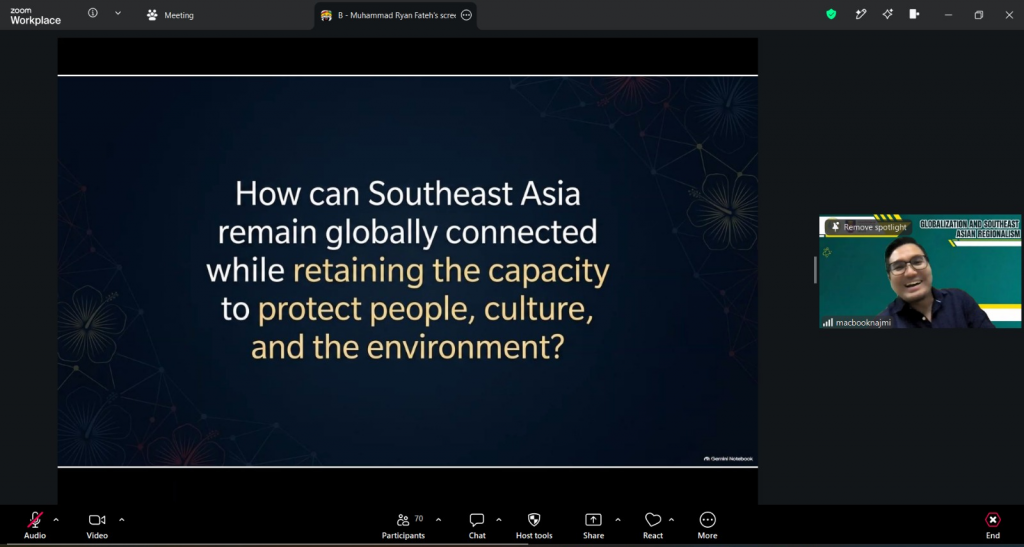
In his presentation, Najmi encouraged students to understand globalization not merely as an economic process, but as a multidimensional phenomenon encompassing political, social, cultural, technological, and environmental dynamics. Amid the uneven impacts of globalization, Southeast Asia holds a strategic position in shaping regional responses through the strengthening of ASEAN Centrality and regional integration.
“Regional integration through ASEAN does not eliminate globalization; rather, it enables Southeast Asian countries to manage it collectively,” Najmi told the students.
The discussion further explored ASEAN’s three main pillars: the Political-Security Community, Economic Community, and Socio-Cultural Community, as well as how these developments influence the practice of strategic communication and public diplomacy across Southeast Asia.
The lecture also invited students to move beyond a purely global perspective and reconsider communication through local and regional contexts. Through the discussion on “Decolonizing PR,” students were introduced to the importance of critically examining the dominance of Western perspectives in public relations theory and practice, while also recognizing communication values rooted in Southeast Asian societies.
Values such as musyawarah mufakat or consensus-based deliberation, respect for social relationships, and the Javanese philosophy “Ajining diri dumunung ana ing lathi”—which emphasizes that a person’s dignity is reflected in the way they speak—were presented as examples of how communication practices can be understood through local cultural contexts. This perspective highlights that strategic communication is not simply about message delivery, but also about understanding values, identity, and the ways communities maintain social harmony.
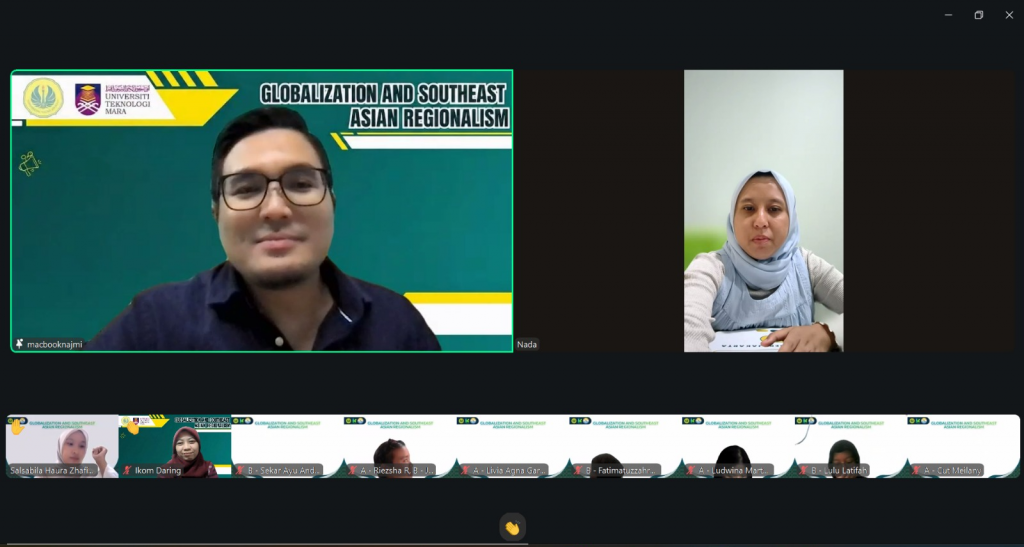
The discussion became increasingly interactive as students examined the role of young people as informal diplomatic actors (Youth as Diplomatic Actors). They were encouraged to recognize that diplomacy in the digital era no longer takes place solely through formal relations between states, but also through interactions among citizens, communities, media, and young people across digital spaces.
Students were also introduced to the Issue Analysis Framework as a systematic approach to examining communication-related issues. Through this framework, students are expected not only to identify global and regional issues, but also to understand the actors, interests, contexts, and communication consequences involved.
The international guest lecture reflects FISH UNJ’s ongoing commitment to providing learning experiences that are increasingly connected to global perspectives while remaining grounded in the social and cultural contexts of the region. Collaboration with an academic from UiTM Malaysia also creates opportunities for knowledge exchange between Indonesia and Malaysia, two neighboring countries with strong geographical and cultural ties that continue to navigate rapidly evolving global communication dynamics.
Through initiatives such as this, FISH UNJ continues to encourage students to develop global perspectives, sensitivity to local contexts, and critical thinking skills in responding to changes in communication at both regional and international levels. The initiative also strengthens FISH UNJ’s international academic network in support of higher education that is increasingly adaptive to the dynamics of a global society (AndienAulia/RyanFateh).