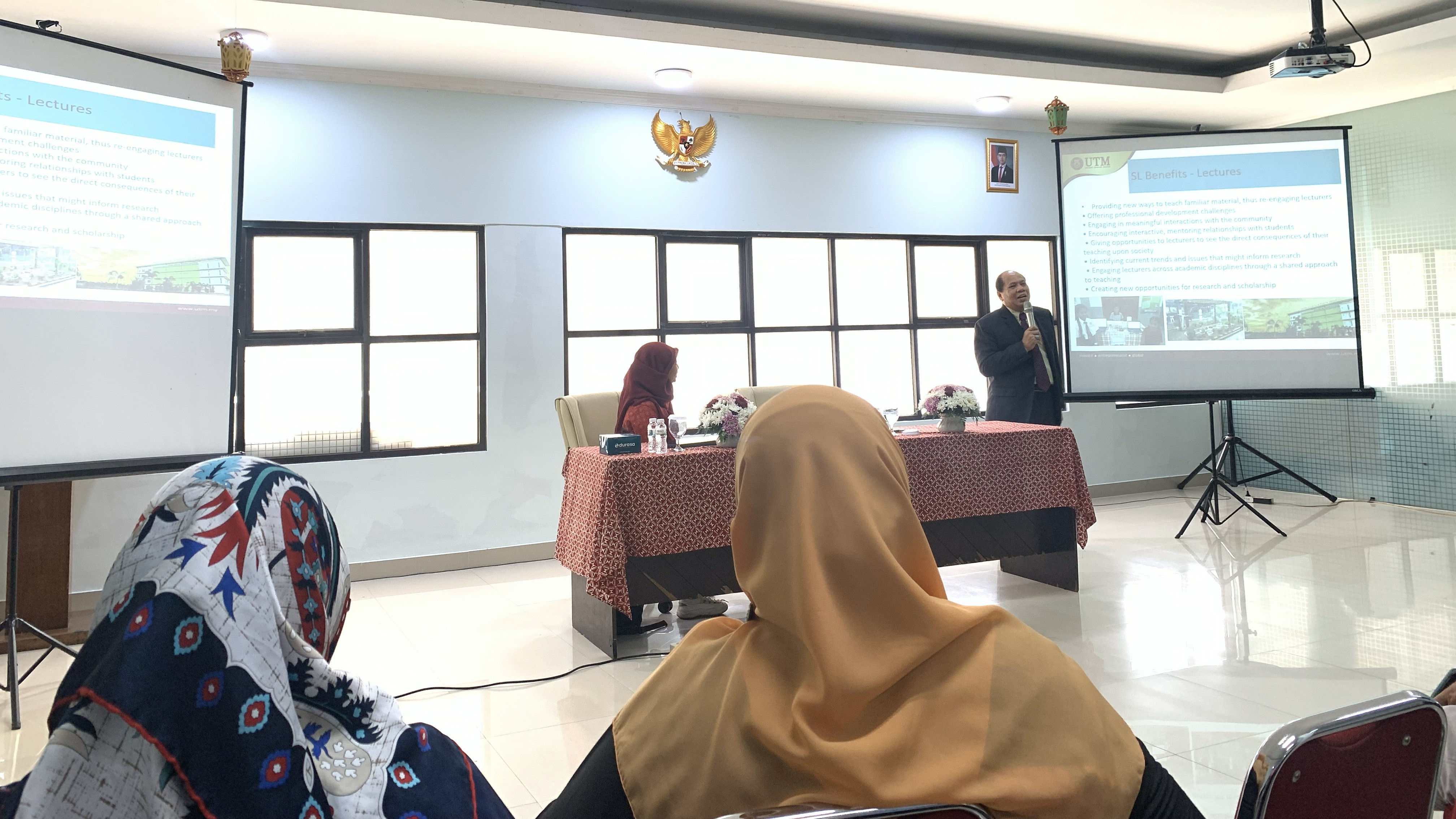
Jakarta, January 7th, 2026 – Undergraduate of Communication Science UNJ participated in an International Article Writing Workshop organized by the Faculty of Social Sciences and Law (FISH) UNJ on Monday, at 08:00 WIB, held at the Multi-Purpose Room on the first floor of FISH UNJ. The workshop featured Associate Professor Dr. Zainudin bin Hassan from Universiti Teknologi Malaysia (UTM) and was attended by study program coordinators and undergraduate students.
The workshop aimed to strengthen academic writing competencies for international publication while introducing the SULAM (Service Learning Malaysia) model as an innovative learning and research approach. Dr. Zainudin shared best practices in integrating academic learning, community engagement, and documentation to support Scopus-indexed publications.
During the session, Dr. Zainudin emphasized that service learning is not merely community service but a structured learning-by-doing method that connects theory and practice. “Service learning is about how we examine, document, and disseminate knowledge derived from real community engagement,” he explained.
He outlined that the SULAM model is built on three core components: academic study, practical experience, and community involvement supported by the Quadruple Helix collaboration among government, universities, industry, and communities. This approach, he noted, provides measurable benefits for students, lecturers, institutions, and society.
The workshop also highlighted the importance of documentation and publication. Dr. Zainudin stressed that every service learning activity must be supported by qualitative and quantitative reports to ensure academic accountability and wider dissemination. He added that UTM actively publishes student service learning outcomes through digital platforms and international journals to reach global audiences.
The Coordinator of Communication Science UNJ, Dr. Dini Safitri, S.Sos., M.Si., CPR., expressed her feelings “This workshop is a strategic step to elevate the academic writing quality and social impact of our students’ research, opening wider opportunities for international recognition.”
One of the participants, Pandu, stated that the workshop broadened his understanding of how academic knowledge can be applied to real social issues. “SULAM shows how classroom theory can be transformed into practical solutions while building essential professional skills,” he said.
The workshop concluded with expectations for future collaborative programs, including pilot service learning projects and structured training, to enhance students’ research capacity and social impact through internationally recognized publications.